
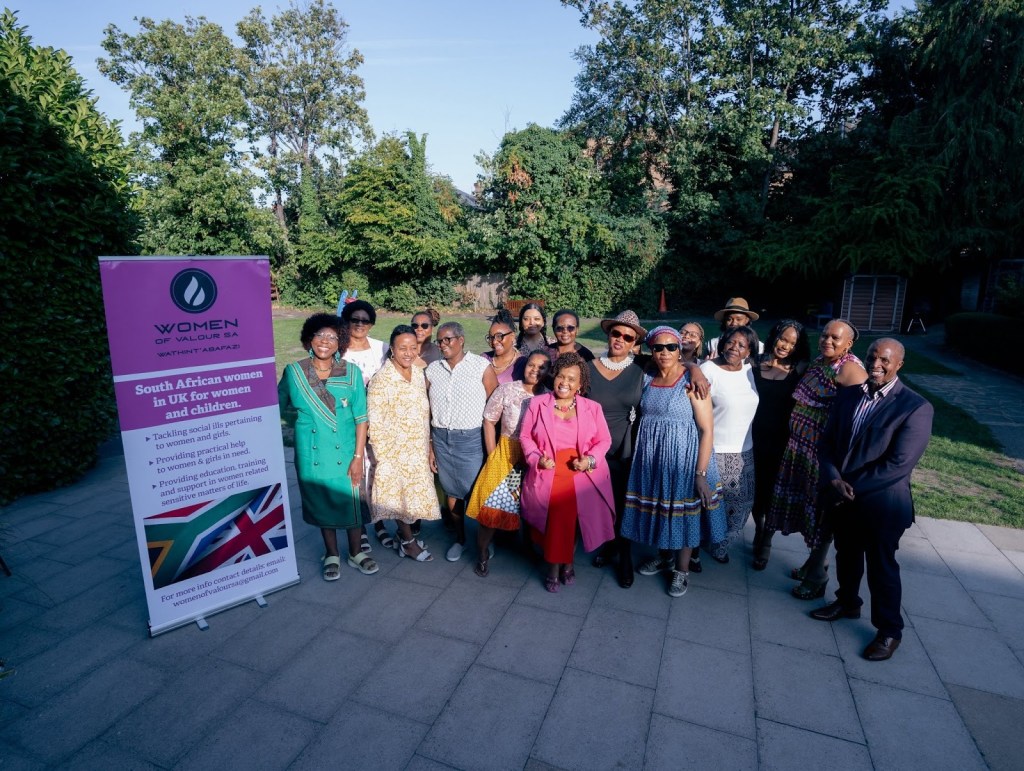
Above: Women of Valour SA-UK , August 2025. I am at the far back.
I Contextualising Transnational Gender Justice
The mobilisation of South African women in the United Kingdom constitutes a significant, yet frequently under-examined, dimension of postcolonial feminist activism. Today I propose to contextualise the operations and ethos of WOMEN OF VALOUR SA/UK (WoV SA/UK)—an organisation 2 founded in October 2021 by Sarah Moloi and inspired by Proverbs 31:10–24 2—as a critical response to the compounded structural burdens faced by the diaspora community. My analysis is framed by an engagement with the organisation’s foundational event, the WOMEN OF VALOUR annual South Africa Woman Day Celebrations, which functions as a visible site of collective agency and identity affirmation
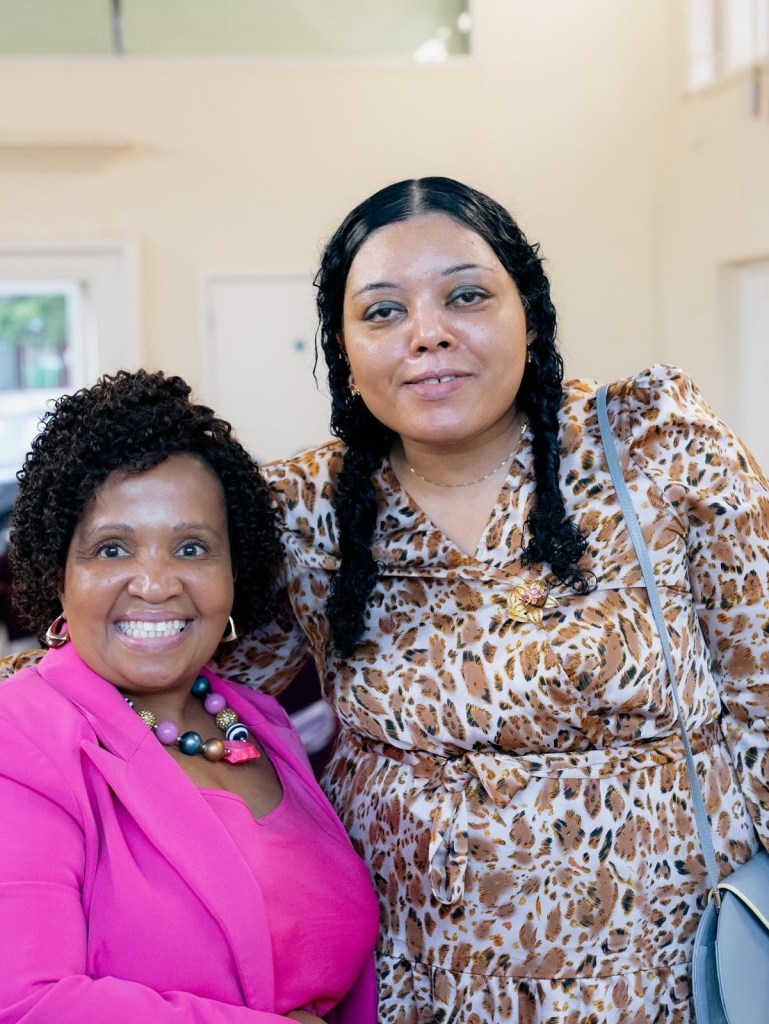
Above: Right Dr (DMD) Gloria Mabasa, and Left: Me, Ariane Denise Brito 11th August 2025
The main focus of my examination is to express the alignment between WoV SA/UK’s grassroots intervention and the transformative activism proposed in localised economic models, such as my sole authoring contribution provided in Stitch and Shelter: A Guide to Creating Safe Havens and Handbag Enterprises in South Africa. I am making the case that the activism materialised by WoV SA/UK and paralleled by the practice of self-reliance detailed in localised enterprise models, operates as a crucial counter-hegemonic response. This response directly addresses the burdens of post-apartheid disillusionment, the replication of patriarchal dominance, and the subtle, yet pervasive, socio-economic pressures exerted within the neo-colonial environment of the UK diaspora.
The visual documentation of the Annual South African Women Celebration event provides compelling empirical evidence of the organisation’s successful institutionalisation and the active deployment of collective agency
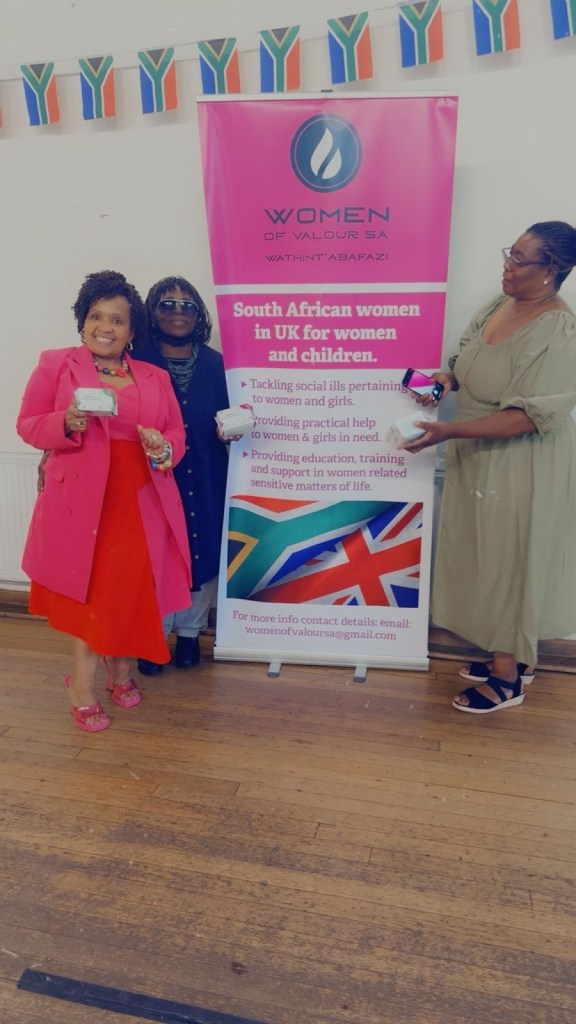
Above: Dr (DDM) Gloria Mabasa with her innovative Dignity Pads, which have been taking the women intimate hygienic market by storm
Specifically, the organisational banner displayed at the event, featuring the combined South African and Union Jack flags, alongside the mission statement, provides the organisation’s logos and ethos. The explicitly stated mission—”South African women in UK for women and children,” focusing on tackling social ills, providing education, training, and support in sensitive matters—articulates a clear agenda of gender-focused communal upliftment.2 The images capturing the communal group and the intimate interpersonal connections serve as profound representations of a collective act of resistance. This assembly effectively creates an affirming “contact zone,” a concept articulated within postcolonial theory to describe the spaces where disparate cultures meet and grapple with asymmetrical relations of power.1 In this context, the event acts against the tendency toward ‘Othering’ often experienced by African migrants in host countries, thus actively combating the structural invisibility of the diaspora community within mainstream UK society.1
Furthermore, the operational scope of WoV SA/UK transcends mere localised support. The organisation’s charitable objects clearly detail a transnational philanthropic and activist loop, encompassing the promotion of equality and education in the UK diaspora while simultaneously aiming for the relief of poverty and the advancement of education of children in South Africa.4 This bifocality validates the study of WoV SA/UK as a phenomenon within diaspora political economy, aligning its functions with the “fourth development aid” model—a categorisation recognising the significant contribution of diaspora-initiated projects to the development of countries of origin.5 This dual mandate underscores the comprehensive and complex nature of South African diaspora political action.
II. Theoretical Apparatus: Postcolonial Feminism and the Imperative of ‘A Luta Continua’
A. The Intersectional Challenge of ‘Dual Oppression’ in the Diaspora
The relationship between postcolonial theory and feminism has historically been characterised by contention, stemming from their respective, sometimes conflicting, strategies for resisting both empire and patriarchy.1 For South African women migrating to the UK, the experience of marginalisation frequently compounds into a complex framework of oppression. This reality mandates an intersectional analysis.1 Postcolonial feminism is defined by a commitment to dismantling both imperial structures and entrenched patriarchy, recognising that the imperial agenda leverages ideologies of racism, gender, class, and culture to sustain domination.1
In the diaspora context, the migrant woman faces a formidable form of oppression that can be characterised as triple oppression: first, navigating the racialised, neo-colonial economic and social structures prevalent in the UK; second, grappling with persistent gendered patriarchy, which may be inherited from traditional cultures or replicated within the host society; and third, bearing the subsequent cultural and psychological burdens of migration itself.1 The UK environment, while often perceived as a venue for enhanced socio-economic mobility, inherently replicates hierarchical relationships historically embedded in markers of race, class, and gender.6 WoV SA/UK thus strategically operates in the “space in between” created by this contact zone 1, addressing the nuanced and specific ways these multiple vectors of oppression intersect to marginalise the South African female migrant community.
B. Decolonising Practice: From Narrative Silence to Embodied Agency
Historiographical analysis reveals a consistent pattern in liberation struggles globally, where the political contributions and roles of women have been subjected to masculine narratives, often leading to the relegation of gender concerns to a “secondary matter”.1 This patriarchal dominance in scholarly literature tends to eclipse women’s voices, positioning them as “passive” actors or merely as domestic supporters of “heroic husbands,” thus influencing the writing of history itself.1 This process is characterised by historiographical negation.
WoV SA/UK’s very existence and naming convention actively challenge this historical negation. The organisation’s name, Wathint’ Abafazi (You Strike a Woman, You Strike a Rock), inspired by the biblical concept of a Woman of Valour 2, is a direct and public assertion of the agency previously denied to women in traditional liberation narratives. The dual mandate of the organisation—simultaneously tackling social ills in the diaspora and promoting educational and economic advancement 4—is an explicit enactment of the “Both Things Simultaneously” approach to activism, a model championed by postcolonial feminists who reject subordinating gender justice to national or economic struggle.1
This activist approach finds its philosophical bedrock in the Setswana concept of Baitiredi (meaning “those who are self-reliant” or “independent workers”).1 In postcolonial literature, the concept of salvation or liberation is constructed as the concerted communal efforts of resistance and the creation of alternative, self-sustaining economic spaces, rather than dependence on the institutions of the oppressor.1 This powerful notion of economic self-actualisation provides the essential theoretical alignment connecting WoV SA/UK’s practical employability programmes 3 with the foundational model detailed in my sole authored book, Stitch and Shelter. The articulation of this Baitiredi imperative transforms the struggle for liberation from a purely political dependency into an ongoing project of self-defined communal economic resistance.1 This commitment to continuous struggle is encapsulated by the concept of ‘a luta continua’ (the struggle continues), affirming that liberation is an unending process requiring constant vigilance and sustained communal effort until justice is achieved for all oppressed members.1
III. The Structural Imperative: Socio-Economic Realities of South African Women in the UK
The necessity for specialised diaspora support organisations like WoV SA/UK is empirically justified by the structural socio-economic realities faced by South African migrant women in the UK, which often involve significant professional and personal vulnerabilities concealed beneath favourable general migration statistics.
A. Migration Dynamics and Professional Assimilation
While general demographic statistics suggest high labour force participation among Black African women in the UK—with unemployment rates sometimes reported as lower than those for White British women 7—this quantitative success often masks profound qualitative challenges in professional integration. Qualitative reports detailing the experiences of highly skilled South African professionals reveal deep assimilation tensions. For instance, South African social workers migrating to the UK noted that their unique South African practice models and professional capital were often marginalised or actively discouraged, compelling them toward a rapid assimilation of local practices.8 This mandated assimilation often results in feelings of professional isolation and reduced effectiveness in culturally nuanced interactions.8 Similarly, the migration of health professionals is frequently influenced by frustration over poor working conditions, low salaries, and inadequate resources in South Africa.10
The implication of these findings is that high employment figures, while indicative of successful labour force entry, fail to capture the qualitative deficit faced by migrant women regarding the recognition of their professional capital and the provision of culturally responsive work environments. This assimilation pressure actively undermines the holistic integration and self-worth of professional migrant women. WoV SA/UK’s organisational mandate, which includes “Employability Support” and “Mentoring” 3, becomes essential for providing a crucial function akin to cultural supervision and professional validation. This intervention ensures that the South African professional identity is integrated and respected, moving beyond the mere exploitation of low-cost labour to affirm the migrant’s full professional capacity.
B. Vulnerability to Gender-Based Violence and Structural Insecurity
Beyond professional challenges, South African migrant women remain highly vulnerable to gender-based violence (GBVF). The need for WoV SA/UK’s focus on “Domestic Violence Prevention” 3 and my published work emphasis on “Safe Havens” is tragically justified by the endemic prevalence of sexual violence within the host country. Data indicates that the UK faces a severe crisis, with 1 in 30 women being raped or sexually assaulted annually, and critically, 1 in 3 adult survivors experiencing the violence within their own homes.11
Migration does not inherently eradicate vulnerability to GBVF. Instead, pre-existing patriarchal structures can be replicated and potentially exacerbated within the diaspora context due to factors such as cultural isolation, lack of robust extended family support networks, and often precarious economic or visa status. The organisation’s focus on tackling social ills and providing targeted support executes a vital feminist political function: intervening in the realm of domestic insecurity often deemed private, and ensuring organisational accountability and community support where state structures may lack cultural competency or trust. This necessity is internationally recognised, demonstrated by the UK’s diplomatic commitment to advancing gender equality and ending violence against women and girls even in South Africa.12 WoV SA/UK thus intervenes to address the structural imperative of safety within the diaspora.
Below I summarise the dynamics of structural challenges faced by South African women in the UK and the corresponding response mechanisms institutionalised by WoV SA/UK.
Table: Structural Context and Organisational Response
| Structural Challenge | Empirical Evidence/Context | WoV SA/UK Operational Mandate | Theoretical Framework |
| Professional Assimilation/Isolation | SA social workers discouraged from using SA practice models; health worker ‘brain drain’.8 | Employability Support, Mentoring, Education, and Training.3 | Decolonising the Mind / Institutional Resistance |
| Gender-Based Violence (GBVF) | 1 in 3 adult survivors of rape experience it at home.11 UK commits to Ending Violence against Women and Girls in SA.12 | Tackling Social Ills / Domestic Violence Prevention.3 | Double/Triple Oppression / Organisational Accountability |
| Diaspora Development Linkage | Diaspora identified as ‘fourth development aid’.5 | Relief of Poverty and Advancement of Education of Children in South Africa.4 | Diaspora Political Economy / Transnationalism |
IV. Materialising Liberation: Stitch and Shelter social theory model application as a practice of Economic Resistance
The model proposed in Stitch and Shelter: A Guide to Creating Safe Havens and Handbag Enterprises in South Africa is not merely a micro-economic plan but a golden historical hallmark for a transformative, intersectional practice of liberation. This model, which structurally links economic autonomy with physical security, directly embodies the postcolonial feminist concept of Baitiredi—the creation of self-reliant individuals and communities.1
A. The Philosophy of Baitiredi and Communal Enterprise
The philosophy underwriting the creation of “Handbag Enterprises” for sustainable livelihood is rooted in cultivating economic self-reliance. This directly mirrors the political movement of Baitiredi, which, in the postcolonial context of resistance against apartheid (equated with boleo, or sin), defined salvation as moving liberation from political dependence to concerted communal efforts of economic resistance.1 By empowering women to become independent producers and entrepreneurs, this model effectively operationalises self-reliance as a fundamental act of structural resistance against oppressive systems.
The creation of enterprises, particularly when linked to a supportive network, rejects the traditional notion of women as passive recipients of aid or dependent economic actors. Instead, the model positions women as active, self-reliant agents whose collective labour subverts dependence on potentially patriarchal or neo-colonial economic structures.13 This commitment to economic independence is understood to be intrinsic to achieving genuine liberation and self-determination.
B. Feminist Political Economy Critique of Empowerment
The materialisation of liberation through enterprise must be rigorously evaluated through the lens of feminist political economy, which demands that empowerment be “fundamentally about changing power relations,” rather than simply granting access to markets.13 Scholars frequently caution that access to markets alone does not necessarily transform underlying hierarchical power structures.13
The Stitch and Shelter model successfully navigates this critique by embedding economic activity within the context of the safe haven. The economic activities (Handbag Enterprises) are physically and psychologically supported by a foundation of security and communal refuge (Shelter). This foundational linkage ensures that the economic activity is not merely an external addition to the women’s existing vulnerability, but is built upon transformed power relations at the personal and communal levels, thus ensuring physical and psychological security before engaging with the wider economic system. The dual mandate of safety and sustainability inherent in the model represents an ideal intersectional practice, ensuring that material support is linked inseparably to personal security.13 The conceptualisation of these enterprise-based safe havens positions the activist not just as a service provider, but as an agent of educational and social reconstruction, attempting to reverse historical disadvantage and pave a new path for future generations.1
V. Diaspora Institutionalisation: The Operational Modality of WoV SA/UK
A. Mandate, Ethos, and Organisational Structure
WoV SA/UK represents a structured institutional response to diaspora needs, operating as a registered charity 15 committed to advancing the equality, education, and diversity of women and young girls, as well as the relief of poverty.4 Its mandate focuses on bridging the gap between the aspirational identity of the South African migrant and the structural realities of life in the UK. The organisation’s explicitly Pan-Africanist reach and community focus distinguish its operations from more narrowly defined, single-issue organisations, confirming its role as a central support network for South African women in the UK.2
A critical dimension of the organisation’s ethos is its grounding in Christian faith, specifically referencing Proverbs 31:10–24.2 This faith-based foundation, often overlooked in mainstream feminist critiques, is instrumental in enhancing community trust and mobilising resources within specific diaspora networks. This approach provides culturally grounded, holistic support that may be perceived as lacking in more secular or mainstream social services. The integration of this theological framework ensures that empowerment addresses spiritual and moral dimensions alongside the economic and social, thereby nurturing a strong, resilient sense of community.
B. DIssecting Social Support via Organisational Accountability (Social DSR Framework)
To rigorously dissect the operational efficacy of WoV SA/UK in addressing preventable social ills, it is instructive to employ an advanced organisational critique, specifically borrowing the structure of the Death Surveillance and Response (DSR) framework utilised in global health systems.1 DSR is a comprehensive framework designed for continuous improvement through the systemic monitoring, reviewing, and responding to preventable adverse events (such as maternal deaths).1 Applying this framework to social adversity reveals WoV SA/UK’s disciplined approach to activism.
WoV SA/UK effectively conducts a Social DSR cycle:
- Surveillance and Reporting: The organisation identifies critical “social ills” pertaining to women and children, including GBVF and economic vulnerability, which are analogous to identifying preventable adverse events.
- Review and Analysis: WoV SA/UK systematically audits structural and social gaps—such as the need for employment skills, lack of mentorship, and domestic threats—rather than auditing clinical files.3
- Response and Monitoring: The organisation implements proactive, non-punitive, and evidence-based actions aimed at preventing future incidents. These responses include Employability Support, Mentoring, Anger Management, and Domestic Violence Prevention.3 Critically, the original DSR model prioritises a “no-blaming” approach to foster collective participation and organisational learning.1 WoV SA/UK’s community-focused, supportive ethos inherently adopts this non-punitive stance, focusing on systemic improvement (training, shelter provision) rather than assigning individual fault, thereby promoting trust and commitment among beneficiaries, which is the necessary organisational culture for effective system change.1
This analogy demonstrates that WoV SA/UK operates not merely as a reactive crisis intervention service, but as an institutionalised system designed for continuous improvement and structured accountability within the diaspora community. The organisation’s actions target the provider (individual training), the system (community structure development), and the broader community levels, mirroring the holistic response recommended by the DSR model.1
VI. The Celebratory and Political Space: Critically Analysing the South African Woman Day Annual Experiences
The Annual Experiences event is more than a social gathering; it functions as a critical site for the public affirmation of postcolonial identity, political mobilisation, and the validation of transnational feminist labour. The event physically institutionalises the organisation’s principles: the mission is publicly declared on the banner, the group photographs signify collective power and success , and the intimate exchanges capture personalised support.
A. The Event as a Site of Identity Affirmation and Communal Kgotla
This annual gathering to celebrate South Africa Women’s Day creates an essential alternative institutional space—a diaspora kgotla (a Setswana term for a public court or meeting space) 1—where South African women, who are often marginalised by the pressure to assimilate in the UK 8 or subjected to structural misogyny, are publicly and collectively validated as women of valour. This act counters the historical trend of historiographical negation, which has frequently relegated women’s political and professional contributions to the periphery.1
For migrant professionals struggling with assimilation tensions—where their culturally specific knowledge is often undervalued 8—an affirming communal event like the Annual Experiences provides a crucial psychological and political space. It allows participants to reconcile their South African heritage with their UK professional reality, actively engaging in the ongoing imperative of “decolonising the mindset.” This process involves liberating ideas and perceptions from the “husk of the Empire” and transforming them into a “new universe of meaning that is life affirming”.1 The event thus serves as a powerful instrument for the decolonisation of the professional and personal self.
B. The parallel roads between the Philosophy and Practices of Wov SA/UK and the ethos of my Stitch and Shelter social theory model
The attendee’s “fantastic experience” at the Annual Experiences event is not simply a subjective feeling of enjoyment; it represents the moment where the foundational philosophy embedded in the Stitch and Shelter model—the imperative of safe havens, enterprise, and self-reliance—finds successful, large-scale institutional validation within the diaspora structure of WoV SA/UK. The organisation’s operational mandates, encompassing employability support, mentorship, and the addressing of social ills 4, tangibly reflect the materialisation of the Baitiredi model at a meso-level. This convergence confirms the efficacy of transnational feminist labour focused on creating systems of support rooted in economic autonomy and collective security.
The following table demonstrates the precise alignment between the micro-level transformative goals of my activist work and the macro-institutional functions of WoV SA/UK.
Table: Alignment of the Separate & Independent Activist Practices: Stitch and Shelter and WoV SA/UK
| Activist Practices Dimension | Stitch and Shelter Model (Micro-Level) | WOMEN OF VALOUR SA/UK (Meso-Level) | Theoretical Linkage |
| Economic Autonomy | Creating Handbag Enterprises for sustainable livelihood. | Employability Support, Mentoring, Self-Help Skills.3 | Baitiredi (Self-Reliance) and Feminist Political Economy.13 |
| Safety and Systemic Protection | Establishing Safe Havens to address physical vulnerability. | Domestic Violence Prevention, Tackling Social Ills, Structured Support.3 | Organisational Accountability (Social DSR) and GBVF Response.11 |
| Identity and Cultural Affirmation | Localised empowerment within South Africa. | Fostering diaspora connection, hosting national holidays, advancing SA culture.2 | Postcolonial Identity and the “Both Things Simultaneously” approach.1 |
VII. Conclusion: Advancing an Intersectional Agenda for Transnational Gender Justice
WOMEN OF VALOUR SA/UK exemplifies a sophisticated, intersectional approach to diaspora activism, effectively moving beyond the theoretical recognition of “double/triple oppression” to implementing practical, systematised solutions. The organisation successfully bridges transnational philanthropic commitments (support for children in South Africa) with immediate, localised diaspora needs (employment support and domestic violence prevention).4 This success is structurally dependent upon blending cultural affirmation, economic empowerment—rooted in the philosophical imperative of Baitiredi 1—and a systematised, accountability-driven response to social vulnerability, as demonstrated by the functional analogy to the Social DSR framework.1
The experiential validation of the Annual Experiences event underscores the socio-political significance of these institutions in providing affirming, culturally resonant “contact zones” necessary for the decolonisation of the migrant professional self.1
For future policy and research, a crucial step involves addressing the empirical deficit concerning South African migrants in the UK. While qualitative data highlights significant professional assimilation tensions and isolation 8, official quantitative data (such as Office for National Statistics data) rarely disaggregates South African-born women by specific professional sectors or track qualitative employment success, thereby failing to capture the unique struggles experienced by these highly skilled migrants.7 Enhanced, targeted data collection is necessary to bridge this epistemic gap and inform policy that truly respects the professional capital of the South African diaspora.
Furthermore, mainstream UK service providers, particularly those addressing GBVF and professional integration, should be encouraged to adopt the non-punitive, systems-focused ethos implicitly utilised by diaspora organisations like WoV SA/UK. This approach emphasises collective responsibility and systemic improvement rather than individual blame, aligning with best practices in organisational accountability.1
Ultimately, the vitality of organisations such as WoV SA/UK affirms the enduring imperative of a luta continua 1, demonstrating that investment in and validation of diaspora-led grassroots initiatives are essential components of advancing holistic, transnational gender justice and postcolonial development strategy globally.
Ultimately, my Stitch and Shelter initiative is the imperative of a new era where transnational feminism requires mass mobilisation of Activists to align with diaspora-led grassroots to reduce women and children vulnerability under the context of neo-colonialism , while pushing for effective transnational gender justice and postcolonial development strategy globally.
Ariane Denise Brito
Author of Stitch and Shelter: A Guide to Creating Safe Havens and Handbag Enterprises in South Africa
Bibliography
Organizational Mandate and Ethos
- Women of Valour SA/UK. “About Us.”
- Women of Valour. “Support/courses that we offer.”
Postcolonial Feminist Theory and Activist Practices
- Dube, Musa W. “Boleo: A postcolonial feminist reading.” HTS Teologiese Studies/Theological Studies 76, no. 3 (2020).
- Mukinda, Fidele Kanyimbu, Asha George, Sara Van Belle, and Helen Schneider. “Practice of death surveillance and response for maternal, newborn and child health: a framework and application to a South African health district.” BMJ Open 11, no. 5 (2021).
- Samuel, Michael, and David Stephens. “Critical dialogues with self: developing teacher identities and roles a case study of South African student teachers.” International Journal of Educational Research 33 (2000): 475–491.
Organizational Charitable Objects
- Charity Commission for England and Wales. “WOMEN OF VALOUR SA/UK (Charitable Incorporated Organisation) Registration.”
Diaspora Development Theory
- Mohamoud, A. A. “Engaging African diaspora in Europe as strategic agents for development in Africa: Seminar Report.” African Diaspora Policy Centre, Brussels, 2008.
Structural Inequality Context
- Walther, D. “Sex, race and empire: White male sexuality and the ‘other’ in Germany’s colonies, 1894–1914.” German Studies Review 33, no. 1 (2010): 45–71.
Programmatic Focus
- Women of Valour. “Support/courses that we offer.”
UK Employment and Migration Data
- Ethnicity Facts and Figures, Government Digital Service. “Unemployment by ethnic group in England and Wales.”
- Ethnicity Facts and Figures, Government Digital Service. “Employment rates by ethnic group in England and Wales.”
- Office for National Statistics (ONS). Labour Market Bulletin: Women’s participation in the labour market.
Professional Assimilation Studies
- Mahlangu, Sinqobile. “South African social workers migrating to the United Kingdom: a descriptive study.” The Social Work Practitioner-Researcher 19, no. 3 (2007).
- Levin, Mark. “South African social workers who migrated to England: experience of cultural differences.” British Journal of Social Work 53, no. 4 (2023): 2019–2037.
Health Migration Drivers
- Mukinda, Fidele Kanyimbu. “A review of the push and pull factors influencing the migration of community service health professionals and their views on the policy restricting their movement.” Human Resources for Health 13, no. 1 (2015).
Gender-Based Violence in the UK
- Rape Crisis England & Wales. “Statistics on sexual violence.”
Diplomatic Commitment to GBVF
- Phillipson, Antony. Address at British and South African high-profile panel discussion. BCB Africa, 2023.
Feminist Political Economy
- Cornwall, Andrea, and Angela Rivas. “Women’s empowerment, if it is to have the transformational effect desired, must be ‘fundamentally about changing power relations.’” Gender and Development 23, no. 2 (2015): 405–419.
Organisational Reach
- Women of Valour SA/UK. “About Us.”
Organisational Activities
- Charity Commission for England and Wales. “Activities – how the charity spends its money.”
Professional Capital Recognition
- Levin, Mark. “South African social workers who migrated to England: experience of cultural differences.” British Journal of Social Work 53, no. 4 (2023): 2019–2037.
Historiographical Negation
- Ndlovu, Ayanda Sphelele, and Chitja Twala. “A Literature Review on the State of Research on Women’s Contribution to South Africa’s Liberation Struggle.” Noyam E-Journal of Humanities, Arts and Social Sciences 5, no. 8 (2024): 1627–1636.
Academic Critique on Data
- Ndlovu, Ayanda Sphelele, and Chitja Twala. “A Literature Review on the State of Research on Women’s Contribution to South Africa’s Liberation Struggle.” Noyam E-Journal of Humanities, Arts and Social Sciences 5, no. 8 (2024): 1627–1636.
I Contextualising Transnational Gender Justice 2
II. Theoretical Apparatus: Postcolonial Feminism and the Imperative of A Luta Continua 6
A. The Intersectional Challenge of ‘Dual Oppression’ in the Diaspora 6
B. Decolonising Practice: From Narrative Silence to Embodied Agency 6
III. The Structural Imperative: Socio-Economic Realities of South African Women in the UK 8
A. Migration Dynamics and Professional Assimilation 8
B. Vulnerability to Gender-Based Violence and Structural Insecurity 9
A. The Philosophy of Baitiredi and Communal Enterprise 11
B. Feminist Political Economy Critique of Empowerment 11
V. Diaspora Institutionalisation: The Operational Modality of WoV SA/UK 12
A. Mandate, Ethos, and Organisational Structure 12
B. DIssecting Social Support via Organisational Accountability (Social DSR Framework) 13
VI. The Celebratory and Political Space: Critically Analysing the Annual Experiences 15
A. The Event as a Site of Identity Affirmation and Communal Kgotla 15
VII. Conclusion: Advancing an Intersectional Agenda for Transnational Gender Justice 18
 ARIANE CRAFTS ANALYSIS
Leave a comment